Carlos Pérez Ricart: ‘There’s never been a better time for the US arms industry than right now’
In his new book, the academic explores the recent history of weapons production in the country and the trafficking of guns to Mexico
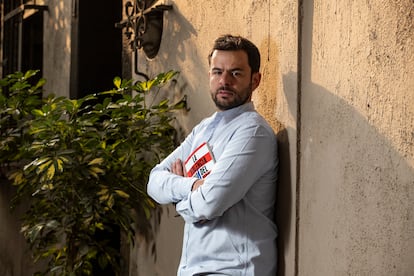

Oftentimes, a handful of statistics works similarly to a shot of mezcal: it gets the person wielding it in the mood. And getting in the mood may well be necessary to understand the universe of Carlos Pérez Ricart, professor and researcher at the Center for Economic Research and Teaching, one of Mexico’s most prestigious universities. So here are a few numbers: in the United States, 14 million firearms are manufactured every year. This equals out to a rate of 114 weapons for every 100 inhabitants, two less than cellular phones, and 24 more than the number of new cars. Such stats seem key to understanding the country’s landscape.
Immersing oneself in the statistical paraphernalia of firearms in North America may sound cliché. Everyone knows that the United States manufactures a lot of guns, that it makes it easy to buy them, that its gun control is minimal and its industry has won its battle against politicians. And few can ignore the number of massacres provoked by the indiscriminate use of such weapons against its population. Sandy Hook, Parkland, Las Vegas, Columbine, to name a few. In his new book, Pérez Ricart attempts to understand how the violence that has menaced Mexico for nearly 20 years drinks from the river of steel that flows from U.S. arms manufacturers, and how U.S. gun industry lobbyists have constructed legal armor around them that is unequaled anywhere else in the world.
His conclusion lies in his latest Spanish-language book’s title, La violencia vino del Norte (The violence came from the north), which was published by Debate and is a plea for increasing regulation around gun production and sales. Such a vision amounts to utopia, he recognizes, and more so in our current moment, with Donald Trump in the White House and federal security agencies converted to vehicles for the Republican’s radical views. Old debates — like that of the need to reinforce restrictions on arms sales and to track weapons that have been used in relation to a crime — seem lost to the wind amid the president’s deregulatory push. “There’s never been a better time for the U.S. arms industry that right now,” says the author.
Mexico, long Washington’s punching bag, suffers the impact of its neighbor’s arms manufacturing, which has grown exponentially since the U.S. assault rifle ban expired in 2004. Many of the weapons wind up on the other side of the border, in the hands of criminal groups, which amass impressive arsenals that are later deployed in their interminable battles, an integral part of the waves of violence that bloody the country. “Without the weapons that came from there, we would not have seen this increase in violence here. And that’s true for Mexico as well as Latin America,” notes Pérez Ricart.
Question. In chapter one, you summarize the causes of violence in Mexico. You later point to the mass arrival of high-caliber weapons. Which is more important?
Answer. I tried to bring everything together that has been written in order to explain the violence. I didn’t try to show which was more important, I don’t really get into that debate, I just recognize that in a complex universe, there are many variables that impact events. What I propose is to underline the role of weapons, to think about things in a different way, to verify that there are signs that firearms could have been the detonator of all this. It is that history, and also how the United States, which was going to be a normal country, was going to regulate the market, in 2004 makes a U-turn and winds up causing bloodshed in Mexico as well as in its own country. The issue of violence in the United Sates is not normal for an industrialized country, in terms of suicide, gender-based violence, homicide — and the production of firearms is part of all of that.
Q. You cover the story of the Brady family. An advisor to Ronald Reagan, James Brady fell victim to an attack on the president in 1981. He nearly died. Then one day, his wife saw their small son with a .22 revolver in his friend’s car, a loaded gun. All this led them to become activists. I mention all this because that part about a “normal” country that you mentioned…
A. In the book, I make reference to Paul Auster, who says that the car and the gun are natural parts of the North American experience. I don’t develop those ideas much further, but my attention is drawn to the fact or the idea that the car and the gun take a man’s strength to another level, they expand his abilities. Look at the case of the Las Vegas shooter. In 2017, he was chronically ill, an old man, fragile… I saw all his videos on YouTube, a person who plays video games, who is weak, is able to achieve that amount of strength with guns.

Q. Superman logic.
A. Exactly. I thought a lot about that, of how a weapon that is so easy to buy, almost as easy as a beer, can expand a person’s ability to do harm, and in addition, it can’t be regulated. I mean, it sounds stupid to say that a person can make a nuclear bomb in their garage, but it should also sound stupid that a person can accumulate 14 or 15 automatic weapons in their home. That really interests me.
The part about Reagan… I realized that it’s there that one of the most important gun control movements is born in the United States, that of the Brady family. And when I started studying the case of Sarah, the wife, I realized how incredible it is that she comes from the Republican Party. I mean, she’s not a radical, on the left, a Democrat, but rather she’s married to one of the most important advisors in the Reagan administration. I said, “It can’t be.”
Q. And the truly illuminating part is how Reagan didn’t pay them any attention until he was no longer in office.
A. It’s incredible. And then he, Reagan, gets together with other former presidents to ask for more regulation. It seems like that happens a lot post-term: presidents become aware of the problem when they leave.
Q. And when they have nothing left to lose.
A. Yes, that too.
Q. You write that the endorsement of the National Rifle Association can account for between 3% and 6% of votes in an election.
A. It’s clear that the NRA and other organizations have the ability to create the perception that they can shift an electoral result. They are a plethora of organizations that receive too much money. And when politicians allowed that money to come in, it made it almost impossible to change the regulations. Because most of the U.S. population is in favor of greater gun control, which is not reflected in their representation.
Q. That’s what you say, that we’re living in an ideal world — at least, for the gun industry.
A. There’s never been a better time. I finished the book 120 days into Trump’s second administration, on the day of his first legal changes. Trump 2.0 came in looking to completely destroy the mechanisms to control guns. The conclusion is clear: in the United States, nothing is going to change. Not the way arms are manufactured, or bullets, or their sale. It’s so complicated how in 15 or 20 years the way arms were regulated in the United States changed. For many years, those of us who work in this field have made efforts to bring about institutional change there. The demands in Mexico are related to this, to transforming the way production is carried out. But today it is clear to me that Trump is the vanguard. He is not an anomaly; he is the way politics are done in the United States.
Q. Another incredible statistic: in the United States, there are 77,813 licenses to sell guns, not including those who sell at gun fairs, secondhand, etc. In Mexico, there are two, and they are held by the army.
A. Yes, that’s more than the number of McDonald’s, Wendy’s, Starbucks — it’s impactful. And when you look at things more holistically, you see that many of these license holders live along the U.S.-Mexico border. And according to one study that I cite, many make their living from the illegal market. It’s impossible to know which…
Q. Impossible because of the legislation itself.
A. And the government’s ability to verify that the points of sale are fulfilling requirements is minimal. And with Trump, now one of his plans is to end the Bureau of Alcohol, Tobacco, Firearms and Explosives, which operates the tracking programs that still exist. We have to do something about that.
Q. You write, “Arms trafficking in Mexico is not sophisticated.” Meaning, this idea of massive arms traffickers, who make $300 million sales, does not correspond with binational reality.
A. It is not sophisticated, in reality, it is very prosaic. There are many ways and the majority of the time, we find small, family-run groups that want to earn a few pesos, and who cross the border with guns several times a week. It’s incredible that you can cross the U.S.-Mexico border without showing a passport. There are no checks. And as long as that is the case, Mexico will always receive weapons. Given the evidence of the role that weapons have in increasing violence, it’s incredible that we haven’t managed to develop these systems of control at all.
The most conservative numbers speak of between 140,000 to 150,000 arms trafficked every year to Mexico. There is no political or judicial model, or police force, that can cope with that. Given the number of weapons arriving in Mexico, there is no model that can withstand such a flow.
Sign up for our weekly newsletter to get more English-language news coverage from EL PAÍS USA Edition
Tu suscripción se está usando en otro dispositivo
¿Quieres añadir otro usuario a tu suscripción?
Si continúas leyendo en este dispositivo, no se podrá leer en el otro.
FlechaTu suscripción se está usando en otro dispositivo y solo puedes acceder a EL PAÍS desde un dispositivo a la vez.
Si quieres compartir tu cuenta, cambia tu suscripción a la modalidad Premium, así podrás añadir otro usuario. Cada uno accederá con su propia cuenta de email, lo que os permitirá personalizar vuestra experiencia en EL PAÍS.
¿Tienes una suscripción de empresa? Accede aquí para contratar más cuentas.
En el caso de no saber quién está usando tu cuenta, te recomendamos cambiar tu contraseña aquí.
Si decides continuar compartiendo tu cuenta, este mensaje se mostrará en tu dispositivo y en el de la otra persona que está usando tu cuenta de forma indefinida, afectando a tu experiencia de lectura. Puedes consultar aquí los términos y condiciones de la suscripción digital.